Please note the following dates - for A2 resit students you are expected to attend these sessions or email me to agree an alternative time and date - preferably Monday after School in the same week of the required mock - tgray@cherwell.oxon.sch.uk
Use your PLC - RAG what you have covered and your confidence level and share with your teacher.
6EC01 - understanding markets and market failure (same content as last mock) plus negative externalities
Thursday - Feb 5th 9am - 10.30am Gym
Friday - Feb 6th 1-2.30pm Gym
6EC02 - Entire course apart from Monetarism (Monetary Policy Committee) - this shadows content covered in A2.
Thursday - Feb 12th 9am-10.30am Gym
Friday - Feb 13th 1-2.30pm Gym
Wednesday, 21 January 2015

Tuesday, 20 January 2015
Supply Side Policies
Government policies that are designed to shift the AS curve to the right are difficult to achieve and may take time. Use the following link for PAJ's summary on Supply-Side Policies:
https://www.youtube.com/watch?v=v9HEm8w5nL8&index=2&list=PL73BD8EE9CB0A4D12
https://www.youtube.com/watch?v=v9HEm8w5nL8&index=2&list=PL73BD8EE9CB0A4D12
Monday, 5 January 2015
Public finances (G-T)
Government Spending
Government spending happens for three reasons:
to provide merit goods
to provide public goods
to meet government priorities
Given the flurry of data in recent years on the state of the Government's finances it is well worth ensuring you understand it. The following are useful links:
 Note from the above the difference between Government expenditure as a percentage of Real GDP excluding benefits, the typical 20-25% of AD quoted in textbooks and the overall around 40% of Real GDP (including benefits - half of which are pension related) quoted in the media.
The ever helpful Economics help study notes: http://www.economicshelp.org/blog/5326/economics/government-spending/
Some interesting data blog graphics from the Guardian:
http://static.guim.co.uk/sys-images/Guardian/Pix/pictures/2013/3/20/1363800264587/Budget-spending-and-tax-r-001.jpg
http://www.theguardian.com/news/datablog/2010/apr/25/uk-public-spending-1963
Complete AS worksheet 60.
Fiscal Policy
Fiscal Policy concerns the manipulation of:
Government Spending
Taxation
the budgetary position e.g attempting to reduce the budget deficit
The Coalition Government have attempted to reduce the Budget Deficit (eighty percent through Government spending cuts and 20% through tax increases such as stopping tax avoidance and increasing VAT.) This is known as AUSTERITY MEASURES or tough/tightening fiscal policy or contractionary fiscal policy.
Discretionary Fiscal Policy - government decides to change government spending to achieve a priority e.g. increase it to achieve growth through the multiplier effect or cut it to reduce inflationary pressures and to reduce government borrowing allowing more loanable funds to be available to the private sector at a lower rate of interest.
Automatic Stabilisers - Germany is said to have had large automatic fiscal stabilisers. This means when the recession happened and people lost their jobs they did not suffer a large fall in disposable income. The reason for this is as benefits and income tax levels are high; so the fall in consumption was made up for by a rise in government spending and a fall in tax revenue so AD did not shift inwards substantially.
Cyclical Deficit - temporary budget deficit caused by recession. Increased spending on benefits given rising unemployment and falling tax revenue due to loss of wages, wage cuts or business paying less corporation tax as profits fall. Deficit may be replaced by a budget surplus in the boom years.
Structural Deficit - long term budget deficit problem caused by low trend growth generating insufficient tax revenue to cover government infrastructure expenditure on NHS, Education, transport etc. For the structural deficit to be removed Governments need to consider:
a) Cutting Government spending on NHS and Education
b) Increasing taxes
c) Increasing trend growth through supply side measures.
Crowding out - Government Spending and Borrowing replaces private sector Investment. Key reason for this is government borrowing results in a lack of loanable funds for the private sector that then has to pay a higher rate of interest on these loans if they still wish to borrow. GOVERNMENT SPENDING REPLACES INVESTMENT, the private sector is more productively efficient.
Ricardian Equivalence - tax payers are rational and expect any government that is cutting income taxes or increasing government spending, by borrowing, before an election - after the election the government will reverse this fiscal policy to pay back the money borrowed. The consequence of this is that the fiscal stimulus is ineffective as tax payers save the income tax cut or public sector wages rather than spend it - so there is no multiplier effect. FISCAL POLICY DOES NOT WORK.
Complete A2 worksheet 87, 95 and 96.
Government spending happens for three reasons:
to provide merit goods
to provide public goods
to meet government priorities
Given the flurry of data in recent years on the state of the Government's finances it is well worth ensuring you understand it. The following are useful links:
The ever helpful Economics help study notes: http://www.economicshelp.org/blog/5326/economics/government-spending/
Some interesting data blog graphics from the Guardian:
http://static.guim.co.uk/sys-images/Guardian/Pix/pictures/2013/3/20/1363800264587/Budget-spending-and-tax-r-001.jpg
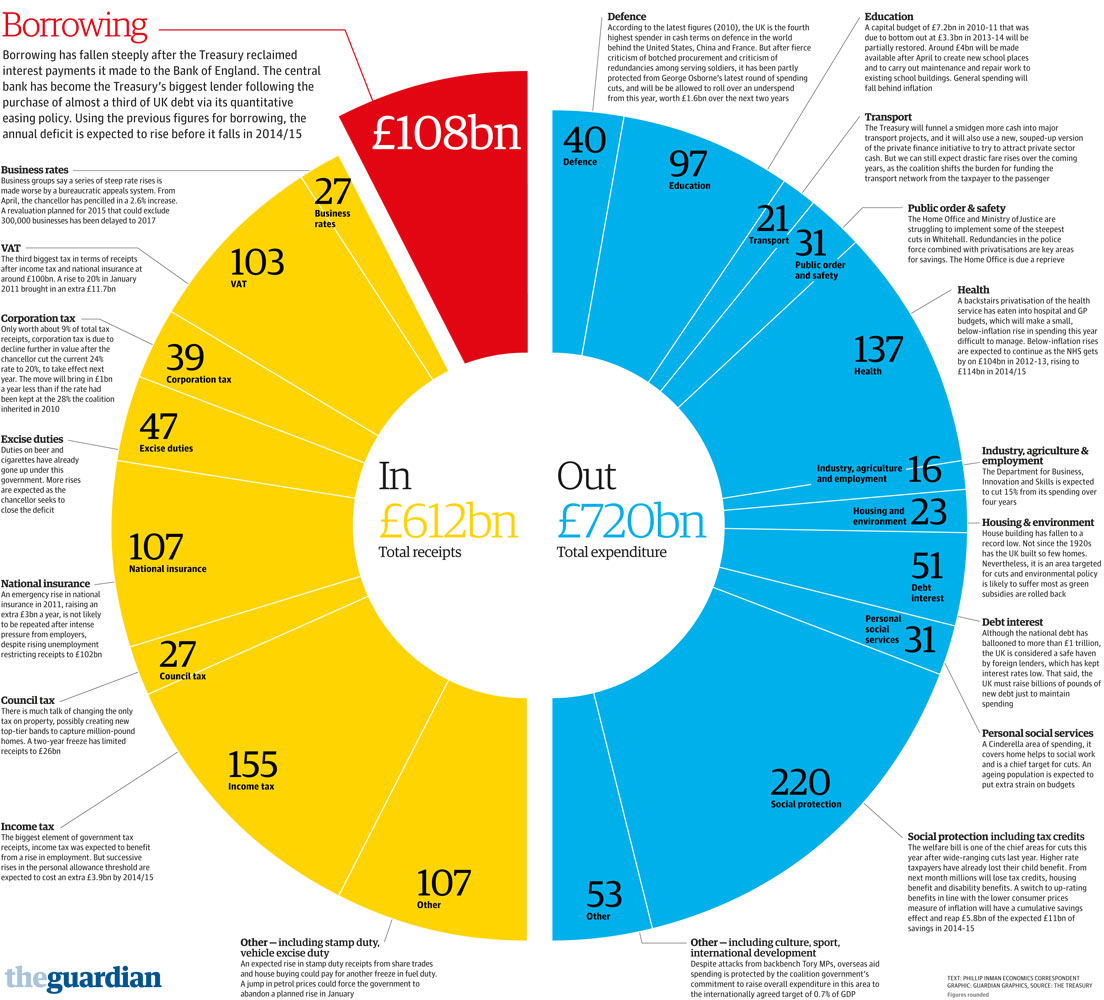
http://www.theguardian.com/news/datablog/2010/apr/25/uk-public-spending-1963
Complete AS worksheet 60.
Fiscal Policy
Fiscal Policy concerns the manipulation of:
Government Spending
Taxation
the budgetary position e.g attempting to reduce the budget deficit
The Coalition Government have attempted to reduce the Budget Deficit (eighty percent through Government spending cuts and 20% through tax increases such as stopping tax avoidance and increasing VAT.) This is known as AUSTERITY MEASURES or tough/tightening fiscal policy or contractionary fiscal policy.
Discretionary Fiscal Policy - government decides to change government spending to achieve a priority e.g. increase it to achieve growth through the multiplier effect or cut it to reduce inflationary pressures and to reduce government borrowing allowing more loanable funds to be available to the private sector at a lower rate of interest.
Automatic Stabilisers - Germany is said to have had large automatic fiscal stabilisers. This means when the recession happened and people lost their jobs they did not suffer a large fall in disposable income. The reason for this is as benefits and income tax levels are high; so the fall in consumption was made up for by a rise in government spending and a fall in tax revenue so AD did not shift inwards substantially.
Cyclical Deficit - temporary budget deficit caused by recession. Increased spending on benefits given rising unemployment and falling tax revenue due to loss of wages, wage cuts or business paying less corporation tax as profits fall. Deficit may be replaced by a budget surplus in the boom years.
Structural Deficit - long term budget deficit problem caused by low trend growth generating insufficient tax revenue to cover government infrastructure expenditure on NHS, Education, transport etc. For the structural deficit to be removed Governments need to consider:
a) Cutting Government spending on NHS and Education
b) Increasing taxes
c) Increasing trend growth through supply side measures.
Crowding out - Government Spending and Borrowing replaces private sector Investment. Key reason for this is government borrowing results in a lack of loanable funds for the private sector that then has to pay a higher rate of interest on these loans if they still wish to borrow. GOVERNMENT SPENDING REPLACES INVESTMENT, the private sector is more productively efficient.
Ricardian Equivalence - tax payers are rational and expect any government that is cutting income taxes or increasing government spending, by borrowing, before an election - after the election the government will reverse this fiscal policy to pay back the money borrowed. The consequence of this is that the fiscal stimulus is ineffective as tax payers save the income tax cut or public sector wages rather than spend it - so there is no multiplier effect. FISCAL POLICY DOES NOT WORK.
Complete A2 worksheet 87, 95 and 96.
Monday, 15 December 2014
Economics Exam Dates - planning for 2015
6EC01 - 11 May am - 90 minutes
6EC02 - 19 May pm - 90 minutes
6EC03 - 11 June pm - 90 minutes
6EC04 - 19 June am - 2 hours
6EC02 - 19 May pm - 90 minutes
6EC03 - 11 June pm - 90 minutes
6EC04 - 19 June am - 2 hours
My free Christmas present for you:the Financial Times
A few years back the Government's chief economics civil servants indicated that the best newspaper for A2 and AS Level Economics students was the FT. Please do use the Christmas break to get the FT for free - where you can weekly access excellent articles by the FT's Chief Economist: Martin Wolf.
See this following link for Martin Wolf's verdict on the recent Autumn Budget statement:
See this following link for Martin Wolf's verdict on the recent Autumn Budget statement:
The battle over the public finances will define Britain
UK's trend growth (productivity) may now be 1% per annum on average
Fiscal receipts (mostly tax revenue) is likely to rise from 35.5% of GDP to 36.2% by 2020.
"Public sector net debt is now too high"
"The case for achieving an overall fiscal surplus in the next parliament is not overwhelming."
Christmas at Econstories
Aside from putting these excellent economics Christmas gifts on your Santa wish list - there is some entertaining material here in understanding the battle of ideas. A battle between those who favour the use of government intervention to put an end to the great recession (the followers of Keynes - Keynesian interventionists) against those who blame the great recession on government intervention and want to see less state intervention (followers of Hayek - free market economists).
http://econstories.tv/fight-of-the-century/ AS introduction (A2 recap)
http://econstories.tv/fear-the-boom-and-bust/
http://econstories.tv/fight-of-the-century/ AS introduction (A2 recap)
http://econstories.tv/fear-the-boom-and-bust/
Thursday, 4 December 2014
UK's trade deficit
Exports and Imports
The demand for exports and imports is influenced by:
Price - changes in costs of production such as cheap wages or price of oil
Price - changes in exchange rates - SPICED - strong pound imports cheaper exports dearer
Income - growth or recession in UK have an impact on what we spend on imports and likewise growth or recession in foreign markets will change demand for UK exports (especially luxury products that have a high income elasticity of demand)
Quality - improvements in UK design, engineering and high technology have made our gods and services more attractive worldwide.
The size of the UK's trade deficit is very volatile.
In 2015 it hit a record 6% of GDP compared to the usual large and persistent 2-3%.
Reasons why:
1. the pound may rise against the euro making the price of our exports less competitive so hitting UK export earnings and making imports more attractive - assuming demand for both is price elastic
2. World recession may also mean less is spent on UK luxury exports e.g Jaguar exports to the BRICS
3. UK economy may continue to grow resulting in the purchase of more imported clothing and electronic products so overall expenditure on imports rises.
However
Less being spent on imports
1. falling oil prices mean we are spending less on oil related imports which are price inelastic
2. deflation in the Eurozone so may be faced with spending less on imported euro goods, assuming demand is price inelastic
3. The UK economy may slow down resulting in lower spending by UK households and firms on imports
EXAM TIPS:
Please note as an exam an important assumption to be made is the Price Elasticity of Demand for exports and imports.

Look at the direction of change when considering the impact on the UK economy e.g using AS/AD assess explain the likely impact on the UK of a widening trade deficit?
see link here for answer: https://www.youtube.com/watch?v=HMGMk-5RZcc&index=7&list=PLB19E61D93CD7E354
Some relevant articles:
http://www.economicshelp.org/blog/1310/economics/uk-trade-deficit/
http://www.bbc.co.uk/news/business-30411134
http://www.tradingeconomics.com/united-kingdom/balance-of-trade
The demand for exports and imports is influenced by:
Price - changes in costs of production such as cheap wages or price of oil
Price - changes in exchange rates - SPICED - strong pound imports cheaper exports dearer
Income - growth or recession in UK have an impact on what we spend on imports and likewise growth or recession in foreign markets will change demand for UK exports (especially luxury products that have a high income elasticity of demand)
Quality - improvements in UK design, engineering and high technology have made our gods and services more attractive worldwide.
The size of the UK's trade deficit is very volatile.
In 2015 it hit a record 6% of GDP compared to the usual large and persistent 2-3%.
Reasons why:
1. the pound may rise against the euro making the price of our exports less competitive so hitting UK export earnings and making imports more attractive - assuming demand for both is price elastic
2. World recession may also mean less is spent on UK luxury exports e.g Jaguar exports to the BRICS
3. UK economy may continue to grow resulting in the purchase of more imported clothing and electronic products so overall expenditure on imports rises.
However
Less being spent on imports
1. falling oil prices mean we are spending less on oil related imports which are price inelastic
2. deflation in the Eurozone so may be faced with spending less on imported euro goods, assuming demand is price inelastic
3. The UK economy may slow down resulting in lower spending by UK households and firms on imports
EXAM TIPS:
Please note as an exam an important assumption to be made is the Price Elasticity of Demand for exports and imports.
Look at the direction of change when considering the impact on the UK economy e.g using AS/AD assess explain the likely impact on the UK of a widening trade deficit?
see link here for answer: https://www.youtube.com/watch?v=HMGMk-5RZcc&index=7&list=PLB19E61D93CD7E354
Some relevant articles:
http://www.economicshelp.org/blog/1310/economics/uk-trade-deficit/
http://www.bbc.co.uk/news/business-30411134
http://www.tradingeconomics.com/united-kingdom/balance-of-trade
Subscribe to:
Posts (Atom)